


When I first published a version of this article, the advice was simple. Build something worth reading, get traffic, then turn that traffic into money with ads, affiliate links, or a store.
The traffic was the business model, and everything else was a way of cashing it in. That held for most of a decade, which is why so many WordPress sites were built the way they were.
It doesn’t hold anymore. Search sends less traffic, AI answers absorb a good chunk of what’s left, and the infrastructure layer has started charging for the rest.
I’ve been at WP Mayor since 2014 and now run it, a site that’s been publishing since 2010. I’ve spent two years rebuilding how it earns rather than waiting for the old numbers to come back. I also run RebelCode, which sells WordPress plugins, so I see this from both sides of the transaction.
So here are six ways to earn from a WordPress site in 2026, what each one really takes, and which ones suit which kind of site. I’ve given the most room to how you take payment, because that’s the part that changed most, and the part most guides still get wrong.
Why the Old Monetization Advice Stopped Working
The clearest signal didn’t come from Google. It came from Cloudflare.
On 1 July 2026, Cloudflare announced that its Pay Per Crawl marketplace was becoming Pay Per Use, so publishers get paid when their content creates value rather than when a bot simply fetches it. Its own data showed that more than half of AI crawler traffic went on re-fetching pages that hadn’t changed, which made charging per fetch feel arbitrary to everyone involved.
If you run ads, the other half of that announcement matters more. Since 15 September 2026, Cloudflare’s defaults have blocked mixed-use crawlers, meaning the ones that blend search, agent use and training, from any page that hosts ads, unless the site owner changes the setting.
That covers new Cloudflare customers, new sites set up by existing customers, and all existing free accounts. The stated aim is to push AI companies into separating search crawling from training and agent use. Whatever you make of Cloudflare picking that default, a large slice of the web now treats an ad-supported page as something a machine should pay to use.
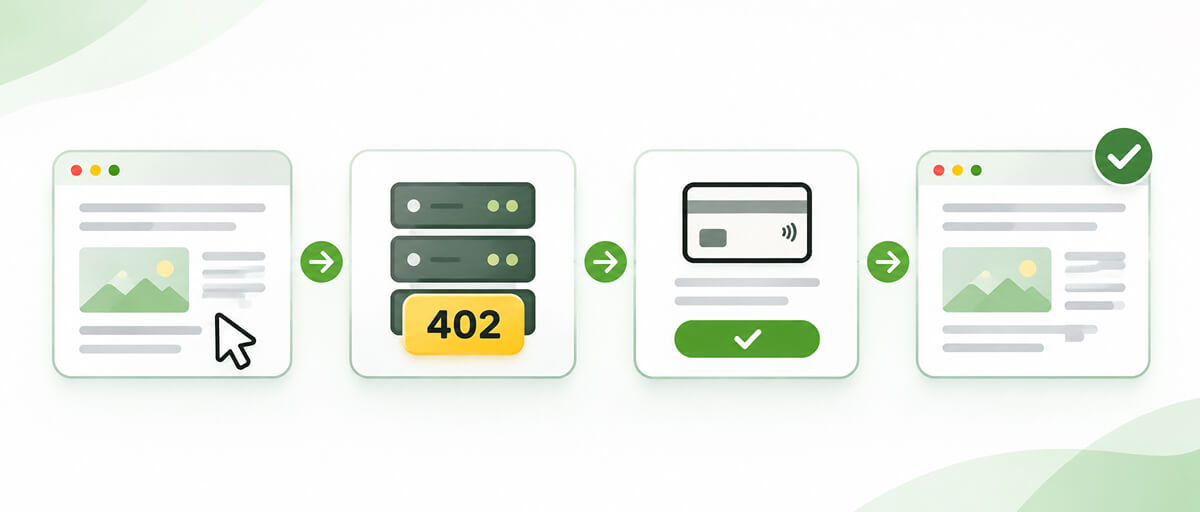
Underneath all of it sits one technical detail worth knowing, because it’s about to turn up in your plugin directory. Pay Per Crawl works by returning HTTP 402, the “Payment Required” status code that has sat unused since the early days of the web, and letting the crawler pay before the content is served.
Coinbase’s x402 standard, introduced in 2025, does the same thing as an open protocol, settling in USDC or through fiat facilitators.
The same mechanism that lets a crawler pay for a page also lets a reader pay for one. That’s what turns this from an infrastructure story into a publishing one.
If a request can carry a payment worth a fraction of a cent, then charging a reader thirty cents for one article stops being silly. On card rails it always was silly, because the processing fee ate the transaction before it cleared. That’s the shift the rest of this article sits on.
Selling Products and Services Directly
This is still the most reliable way to earn from a WordPress site, and the one least affected by everything above.
If you sell a plugin, a course, a physical product, or your own time, a drop in search traffic hurts your top of funnel. It doesn’t change the economics of the sale itself, because you keep the customer relationship and you set the price.
For most people that means WooCommerce, still the default for anything with a cart, or a lighter digital-downloads setup if you’re selling files rather than inventory. Our comparison of which WordPress ecommerce plugin to actually use covers the alternatives if a full store is heavier than you need.
The honest caveat is that running a store is a business, not a monetization tactic. You’re signing up for support, refunds, tax handling, and a checkout you have to keep working. Our guide to WooCommerce payment methods covers the gateway side of that decision.
Where this gets interesting for publishers is productized services. If you’ve built an audience around a subject, what they’ll pay most for is usually your judgment applied to their situation, rather than more articles about it.
That’s fewer transactions at higher value, which is a very different business from selling attention by the thousand.
Charging Readers Per Piece of Content
Every publisher hits the same wall here. You’ve got an archive full of things people would happily pay a small amount for, and no way to charge a small amount, because a thirty-cent card transaction loses money before it clears.
So the archive either stays free and earns from ads, or it goes behind a subscription that asks a casual reader for a monthly commitment they’ll never make for one article.
Micropayment tooling exists to close that gap, and it’s worth knowing how these plugins get around the fee problem, because they do it in one of three ways.
Some hold a balance in a platform wallet, so transactions on your site are deductions from a pre-funded account rather than individual card charges. Some settle on rails where tiny amounts are viable, which in practice means a stablecoin or the Lightning Network. Others batch a reader’s small purchases and charge the card once at a threshold.
The Options Worth Knowing
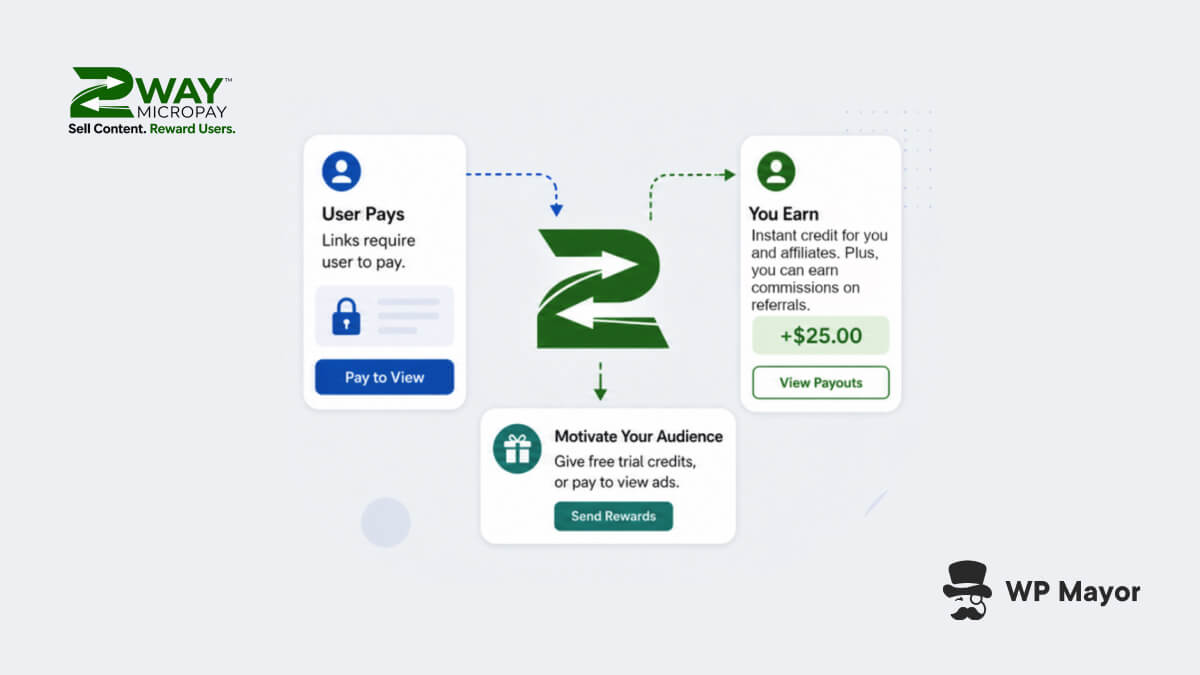
2WayMicropay, from Qixit, takes the wallet approach and adds something the others don’t. Alongside charging for posts, pages, downloads, and media, it can send credits the other way, so you can hand a visitor trial credits or pay them for completing an action before they’ve funded anything themselves.
On the charging side it covers pay-once-view-forever, pay-per-view, time-limited and session-only access. It can also charge for submitting a comment, or for author and contributor rights on a multi-author site. There’s a bulk action in the Posts screen for converting an archive in groups, which matters if you’re testing this across a few hundred old articles.
Two things to understand before you commit. The balance is held in Qix Credits, which Qixit describes as platform credits. To redeem credits as cash, vendors must verify their identity, tax status, and have earnings of at least $100. Vendor credentialing also costs ten dollars on top of a free account.

codoc is the most widely installed of this group, with more than 2,000 active installations. It works through a block in the editor that marks where free content ends and paid content begins, covering paid articles, reader plans, and tipping, with payments running through Stripe.
Two things to check before you get attached to it. Creators have to reside in Japan, the United States, or the EU and hold a bank account there. And while the plugin is still being updated, its tested-up-to version trails the current WordPress release by enough that the directory shows a compatibility warning on its page.
Zlick Paywall sells both subscriptions and one-off access and advertises no upfront cost, taking its cut from the transactions instead. That makes it a low-commitment way to find out whether your readers will pay for anything before you’ve spent money finding out.
Then there’s a newer group built directly on x402, including x402 Pay for crawlers and bots and TransX402 Paywall for posts and pages. Both settle in stablecoins, and both are very early, sitting in the plugin directory’s smallest install brackets with no reviews between them. Treat them as something to watch rather than a revenue line.
If you’re already running a membership plugin, check before you add anything, because Paid Memberships Pro and ARMember both offer pay-per-post add-ons that may cover you without a second system.
Where This Fits
I’d be wary of anyone telling you micropayments are about to replace subscriptions. The honest case is narrower than that, and more useful.
If you’ve got a deep archive, readers arriving from search for one specific thing, or content with obvious standalone value such as a report or a download, then per-item pricing captures money from people who were never going to subscribe. Right now those people cost you bandwidth and give you nothing back.
That’s additive revenue on traffic you already have, which is a very different proposition from asking your core readers to pay more.
Memberships and Subscriptions
Recurring revenue is still the strongest position a publisher can be in, because it’s the only model here where you know roughly what next month looks like.
The trade is that it asks for commitment before the reader has much evidence you’re worth it, and it only works if you’re making something they’d actually miss.
The plugin side is mature and well covered, with MemberPress, Paid Memberships Pro, Restrict Content Pro, and Memberful all doing the job at different price points.
The decision that actually matters isn’t which plugin, it’s what sits behind the wall. A membership that gates articles competes with everything else the reader could read instead. One that gates a community, a tool, a dataset, or direct access to you competes with nothing.
My suggestion is to pair this with the section above rather than choose between them. A per-item price on the archive gives casual readers a way to pay you at all, and the membership gives the regulars a reason to stop paying per item.
The per-item purchase is what proves your content is worth money, before you ask anyone for a subscription.
Advertising and Sponsorship
Of the six models here, programmatic advertising is the one under most pressure, and September’s change at Cloudflare explains why on its own.
An ad-supported page now carries a cost it didn’t a few years ago, because the machines reading it aren’t seeing the ads. The infrastructure layer has started treating that as something to price rather than tolerate.
That doesn’t make advertising dead. It makes network advertising a poor deal at small scale.
Selling your own placements directly is a different business, and a considerably better one, because you’re pricing access to a specific audience rather than taking whatever the network pays per thousand impressions. We sell sponsorship on WP Mayor directly for exactly that reason, and the rates bear no relation to what a network would pay for the same inventory.
The catch is that you have to describe your audience in a way a buyer recognizes, which means knowing who reads you and what they do for a living.
For a niche site with a few thousand of the right readers, that’s an easier sell than it sounds. For a general-interest site with a hundred thousand of the wrong ones, it’s close to impossible, which is roughly the inverse of how programmatic values those same two sites.
Affiliate Revenue
Affiliate income has held up better than advertising, which isn’t the same as holding up. It’s well down on where it was a few years ago. What’s worth understanding is why it hasn’t fallen as far.
An ad gets paid for an impression, which an AI summary destroys. An affiliate link gets paid for a purchase, which still needs a person to click through and buy. That traffic is high-intent, and high-intent traffic is the kind least likely to be satisfied by a generated answer.
What has changed is the ceiling. Thin comparison content assembled for the keyword rather than the reader is exactly what AI answers replace, so the affiliate sites losing ground are the ones that were never adding much.
If you’ve actually used the products, your recommendations survive the shift. Our roundup of affiliate marketing plugins covers the tooling for managing the links once you have them.
The part people get wrong is treating this as passive. At any real scale it means maintaining the content, tracking what converts, and renegotiating rates with the programs sending you the most, which is account management rather than a set-and-forget income stream.
Getting Paid by Machines
This is the newest line on the list and the one with the least evidence behind it, so I’d treat it as an experiment rather than a plan. The premise is that AI crawlers and agents are already reading your site in volume, and there are now mechanisms for charging them.
Cloudflare’s Pay Per Crawl is the route with the least work involved, because Cloudflare acts as merchant of record, charges the crawler, and distributes the earnings. You don’t build any payment infrastructure yourself, though you do need a dedicated Stripe Connect account, and payouts are subject to settlement periods and minimum thresholds. It’s also still in closed beta according to Cloudflare’s own documentation, so turning it on may mean joining a waitlist rather than flipping a switch today.
Pay Per Use, announced in July with Ceramic.ai and You.com as launch partners, extends the idea to paying you when your content surfaces in a generated answer, or when an agent pulls premium content into a session, rather than when it’s merely fetched. That one is in beta too.
Realistically, almost nobody is earning meaningful money from this yet, and the AI companies have to agree to pay for any of it to work.
What makes it worth a mention rather than a dismissal is the plumbing. It’s the same HTTP 402 mechanism the reader-facing plugins use, so a site set up to charge a person a small amount for an article is most of the way to charging an agent for the same thing. If you’re building in this direction anyway, building once for both audiences is the sensible order.
Jean wrote about the adjacent opportunity for anyone running an aggregator site, where the asset is a curated feed rather than individual articles, and that piece is worth reading if your site is more pipeline than publication.
Which Model Fits Your Site
Most sites end up running two or three of these rather than picking one, but they shouldn’t all start at once. This is roughly how I’d judge which belongs where.
| Model | Works best for | Traffic needed | Effort to start | Revenue pattern |
|---|---|---|---|---|
| Direct sales | Anyone with a product, service, or expertise to sell | Low | High | Lumpy but high value |
| Per-item payments | Deep archives, standalone reports, media, downloads | Medium | Low | Small amounts, high volume |
| Memberships | Sites with a returning core audience and something to gate | Medium | High | Predictable and recurring |
| Direct sponsorship | Niche sites with a describable audience | Low | Medium | Lumpy, contract-based |
| Affiliate | Review and comparison content from real use | High | Medium | Variable, follows intent |
| Machine payments | Sites already being crawled heavily | High | Low once you have access | Unproven, still in beta |
What I’d Actually Do First
Say you’re running a site that earns from ads and affiliate links, and you’ve watched both soften. The first move isn’t adding a fourth revenue line. It’s finding out whether anyone will pay you directly for anything at all.
That question is cheaper to answer than it used to be, because per-item pricing lets you test it on content you’ve already published, without building a product or asking for a subscription.
Pick ten pieces from your archive that still get search traffic and have obvious standalone value. Put a price on them that feels slightly too low, then leave them alone for a month.
What you learn is whether your audience contains people willing to pay you, which is the single most useful fact about your site’s commercial future. If nobody buys, you’ve spent an afternoon and learned something real. If they do, you’ve found the group worth building a membership or a product for.
The broader point is that the sites coming through this period in decent shape are the ones that stopped treating traffic as the product. Attention was always rented from a search engine, and the rent went up.
A reader who has paid you something, however small, is a relationship you own. That’s the asset worth compounding from here.



4 Responses
Hey Sean,
Thank you for the awesome post. Monetisation is certainly not as easy as it sounds, is it? There’s just so much work to put in, upfront, that most people even give up before the site could get to a point where it can start making some money. Also true that you got to know where to dig for gold.
Now, it gets even more trickier if we are trying to sell services. In these cases, do you think using affiliate marketing as a monetisation method makes sense?
Ash
For any project revenue is most important.you have shown a great effective ways to profitable site.
Love to read it Sean.!!!
Your comment about how many plugins is way off base. There are (as of Mar 18) Extend your WordPress experience with 54,362 plugins. From:https://wordpress.org/plugins/
Hello James,
Thank you for your kind comment, I will have that in mind for future posts.